Kurultai and Elections Among the Turks: Legitimacy on a Felt Carpet
From the Göktürks to Genghis Khan, the kurultai confirmed, sometimes chose and constrained the ruler. What the historical sources actually say.
Read this piece in Turkish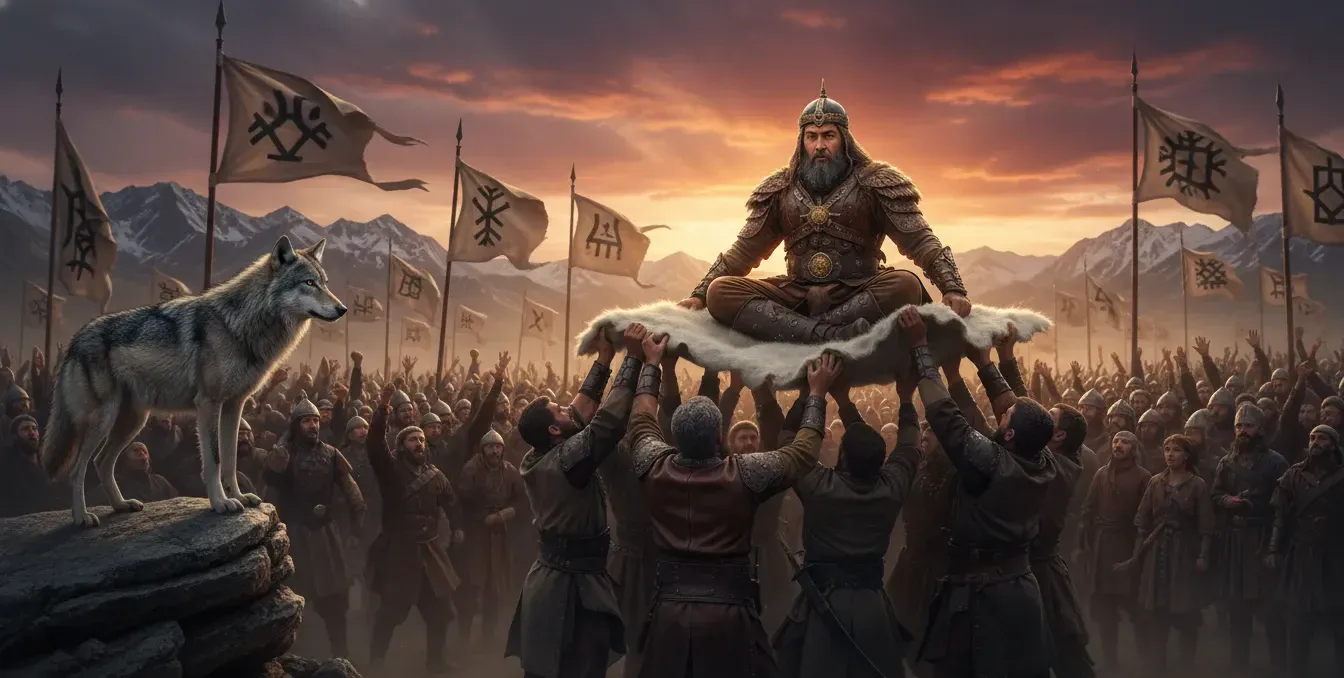
Contents
The first time I read the Chinese account of a new Göktürk khagan taking power, one detail stayed with me. The ruler was carried on a felt carpet and turned nine times in the direction of the sun, and at every turn the leading men of the state bowed before him. Then they put him on a horse, tightened a silk cord around his neck until he could barely breathe, and the moment they let go they asked: “How many years can you be khagan?” [1]
That scene explained power on the steppe better than pages of theory. The khagan was raised up, but the hands that carried him, and the hands that held the silk, belonged to others. This piece is about the institution behind those hands: the kurultai.
From toy to kurultai: one council, two names
What we now call the kurultai begins in Turkic history under an older name, toy. It was the state council of the Hun, Göktürk and Uyghur states, and the kurultai is considered its continuation [2]. The word toy was used in Turkic for roughly two thousand years before giving way, from the 12th century onwards, to the Mongolian-derived kurultai [2][3].
The name changed; the function largely did not. The sources give the toy three core powers: confirming the ruler, choosing a khagan when necessary, and making töre, the unwritten customary law of the steppe [2][3]. That last power matters. Töre was not the khagan’s personal decree but the council’s shared decision.
One more detail: refusing to attend the toy was treated as rebellion against the state [3]. The council was not decoration. It was one of the load-bearing parts of the political order.
Does the khagan come from Heaven or from the council?
In pre-Islamic Turkic statecraft the khagan was believed to receive his mandate from the Sky God and to be its representative on earth [4]. Doesn’t that make a council unnecessary?
Ayten Akcan’s 2025 study gives a clear answer. The kurultai was the most powerful governing body after the khagan himself. It decided who would become khagan, decided on war and peace, supervised the khagan’s decisions and could limit his powers when he decided badly [4].
Legitimacy on the steppe therefore stood on two legs: a mandate from above and the consent of the lords below. In my reading, the felt ritual staged both in a single scene. The ruler turning with the sun displayed his bond with Heaven; the lords bowing at each turn displayed their consent. And the question asked over a silk cord, “how many years?”, reminded everyone from the very first day that power has an end.
Genghis Khan’s kurultai: election or endorsement?
The best-known kurultai took place in the spring of 1206. At the source of the Onon river, Temüjin gathered all the Mongol and Turkic tribes that had already submitted to him [2]. A nine-tailed white standard was raised, and at the end of the assembly Temüjin was proclaimed khagan under the title “Genghis” [5].
Honesty requires a caveat. The 1206 kurultai was not a free election in any modern sense. By then Temüjin had already brought the steppe rulers, above all the Naiman Tayang Khan, Ong Khan and Kutuku-Beki, under his control [5]. The kurultai put a legal and sacred seal on a supremacy won in the field.
The seal still mattered. After Genghis, Ögedei was chosen in 1229 on the Kerulen, Güyük in 1246 near the Orkhon and Möngke in 1250 at Alakmak, each by a kurultai [3]. The 1246 assembly drew governors from Transoxiana and Iran, a Russian prince, Georgian and Armenian representatives and envoys of the Seljuk sultan of Anatolia [3]. The kurultai was where power-holders from every corner of the empire recognised the new ruler.
The moment the seal broke
How a tradition ends is often more instructive than how it worked. According to the TDV Encyclopedia of Islam, Kublai had himself proclaimed Great Khan in 1260 without convening a kurultai, and with that the great kurultai of the Mongol tradition came to an end [3]. The entry treats Möngke’s assembly of 1250 as the last true kurultai [3].
A khaganate proclaimed without a kurultai drew its legitimacy no longer from the consent of the lords but from the force at its disposal. To me, that was the moment the hands holding the four corners of the felt were first treated as unnecessary.
The word survived. What happened to the felt?
The word lived on into the Turkish Republic: on 26 September 1932 the First Turkish Language Kurultai opened at Dolmabahçe Palace [3]. Today the word simply means the general assembly an organisation holds to discuss important matters [2][3].
We kept the word. Whether we kept the power of the hands that held the felt is another question. When a leader walks into a party congress today, can the hands that carried them there still hold the silk, or can they only applaud?
Sources
- Zhoushu (Book of Zhou), chapter 50, section on the Turks — Chinese text, Wikisource
- Kurultay — Küre Ansiklopedi (Turkish)
- Ahmet Taşağıl, “Kurultay”, TDV İslâm Ansiklopedisi (Turkish)
- Ayten Akcan, “Kagan and Kurultays in Pre-Islamic Turkish State Administration”, Akademik Tarih ve Düşünce Dergisi 11/6 (2025)
- Mustafa Kafalı, “Cengiz Han”, TDV İslâm Ansiklopedisi (Turkish)
The views in this piece are my own and do not represent the organisations I am part of.