SEO, AEO and GEO in the Age of AI: Three Acronyms, One Question
As search engines turn into answer engines, how does content stay visible? The difference between SEO, AEO and GEO, what research shows and what Google says.
Read this piece in Turkish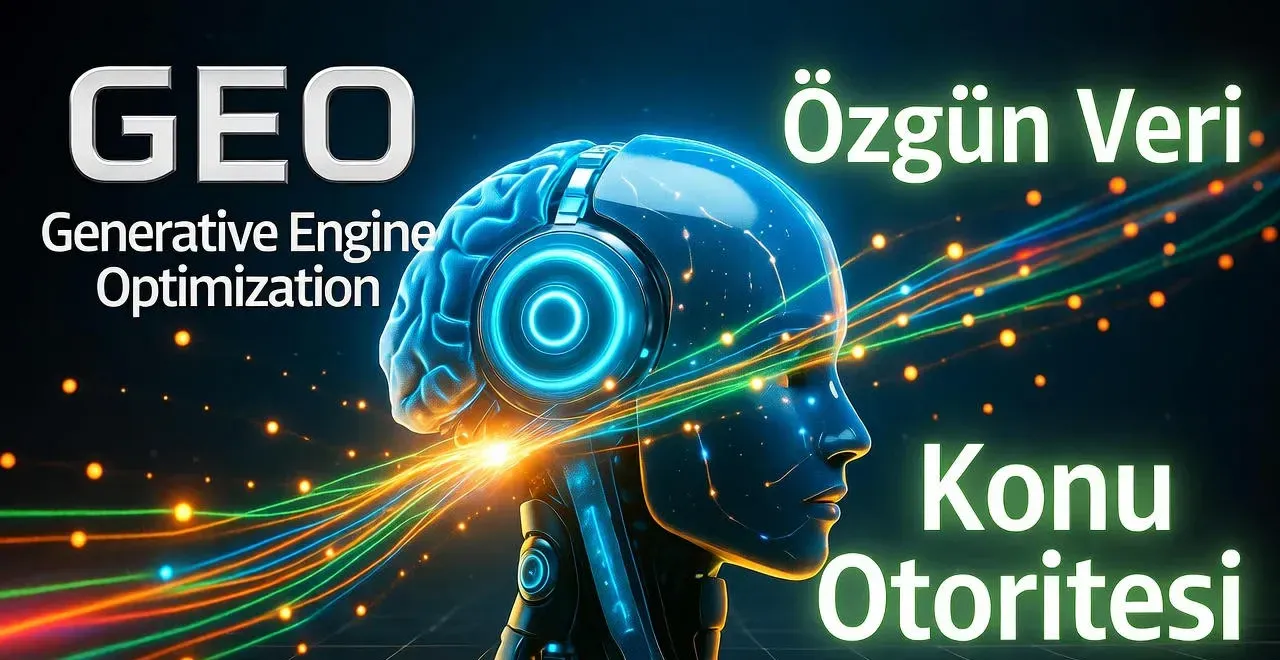
Contents
While building this site, the question I spent the most time on was not design or animation but something invisible: who is going to read these pieces? The answer used to be simple. People searched on Google, clicked a link and landed on the page. Today, someone who asks an AI the same question often gets their answer without clicking anything.
That shift has brought three acronyms to the fore: SEO, AEO and GEO. In this piece I want to look at what each means, what the research says and what the largest search engine itself says about it.
Three acronyms, three different goals
SEO (Search Engine Optimization) is the foundation of digital visibility: the work of getting a page to rank high in search results [5].
AEO (Answer Engine Optimization) aims to produce content that gives direct, concise answers to users’ questions [5].
GEO (Generative Engine Optimization) aims to make content understandable, trustworthy and quotable for AI systems [5]. The goal is not to climb a ranking but to be cited as a source inside an answer an AI generates.
To me, what separates the three is not technique but the question each one asks. SEO asks “can they find me?”, AEO asks “can I answer their question?”, and GEO asks “will they quote me?”
GEO’s academic birth
GEO was born not as a marketing slogan but in a research paper. The study by Pranjal Aggarwal and colleagues, published in 2023 and accepted at the KDD conference in 2024, defined GEO as a new paradigm to help content creators improve their visibility in generative engine responses [1].
To measure it, the researchers built GEO-bench, a large benchmark of user queries across many domains [1]. The result was striking: with the right methods, content visibility in generative engine responses could be increased by up to 40 percent [1].
One caveat when reading that figure: “up to 40 percent” is a ceiling, not a guarantee. But the message is clear. Which source an AI chooses to quote is not random; it depends on how the content is written.
What does Google say?
Interestingly, the world’s largest search engine speaks about this in a fairly calm tone. According to Google’s developer documentation, there are no additional requirements or special optimizations needed to appear in AI Overviews or AI Mode [2]. The page says you do not need new machine-readable files, AI text files or special structured data for these features [2].
Google’s formula is short: SEO best practices remain relevant for AI features [2]. To be shown as a supporting link, a page must be indexed and eligible to appear in Google Search with a snippet [2]. Google also explains that these features may break a question into subtopics and run separate searches for each, a technique it calls “query fan-out” [2].
Then there is content quality. Google says its systems aim to prioritise helpful, reliable information created for people, and that of the E-E-A-T criteria (experience, expertise, authoritativeness and trustworthiness) trust is the most important [3]. It also states plainly that using generative AI to produce large amounts of text without manual oversight represents little to no effort [3].
What about llms.txt?
This site has a file called llms.txt at its root. The idea was proposed by Jeremy Howard in 2024: add a Markdown /llms.txt file to websites to help AI agents use them [4].
Google says it is not needed for its own AI features [2]. I added it anyway, because it costs almost nothing and Google is not the reader’s only search engine. I think the right attitude is to treat the file not as a magic key but as a small courtesy.
What did I do on this site?
Setting theory aside and looking at my own practice, every decision on this site follows the same logic. Every piece ends with a numbered list of sources, because anyone who wants to be quoted should first cite. There is a glossary, because a clear definition is the sentence an AI finds easiest to quote. And every piece carries a note saying it is my personal view, because trust, as Google also says, is the foundation of everything.
I prepare these pieces with AI assistance, but none of them is published without my approval. For me, that is the concrete meaning of Google’s emphasis on human oversight.
The real question
Debating the difference between SEO, AEO and GEO is useful. But in my view all three lead to the same place: content that genuinely tells the reader something, shows its sources and has a person standing behind it.
As search engines become answer engines, what is really changing: how content is optimised, or whose voice is considered worth quoting?
Sources
- Pranjal Aggarwal et al., “GEO: Generative Engine Optimization”, KDD 2024 (arXiv:2311.09735)
- Google Search Central, “AI features and your website”
- Google Search Central, “Creating helpful, reliable, people-first content”
- Jeremy Howard, “The /llms.txt file”, llmstxt.org
- Vedat Karabulut, “SEO, GEO, AEO: Dijital görünürlüğün yeni üçlüsü”, CNN Türk, 8 December 2025 (Turkish)
Glossary: AEO (Answer Engine Optimization), E-E-A-T, GEO (Generative Engine Optimization)
The views in this piece are my own and do not represent the organisations I am part of.